

ME-1.25 Molecular Encapsulator for Lab-Scale CO₂ Formulation
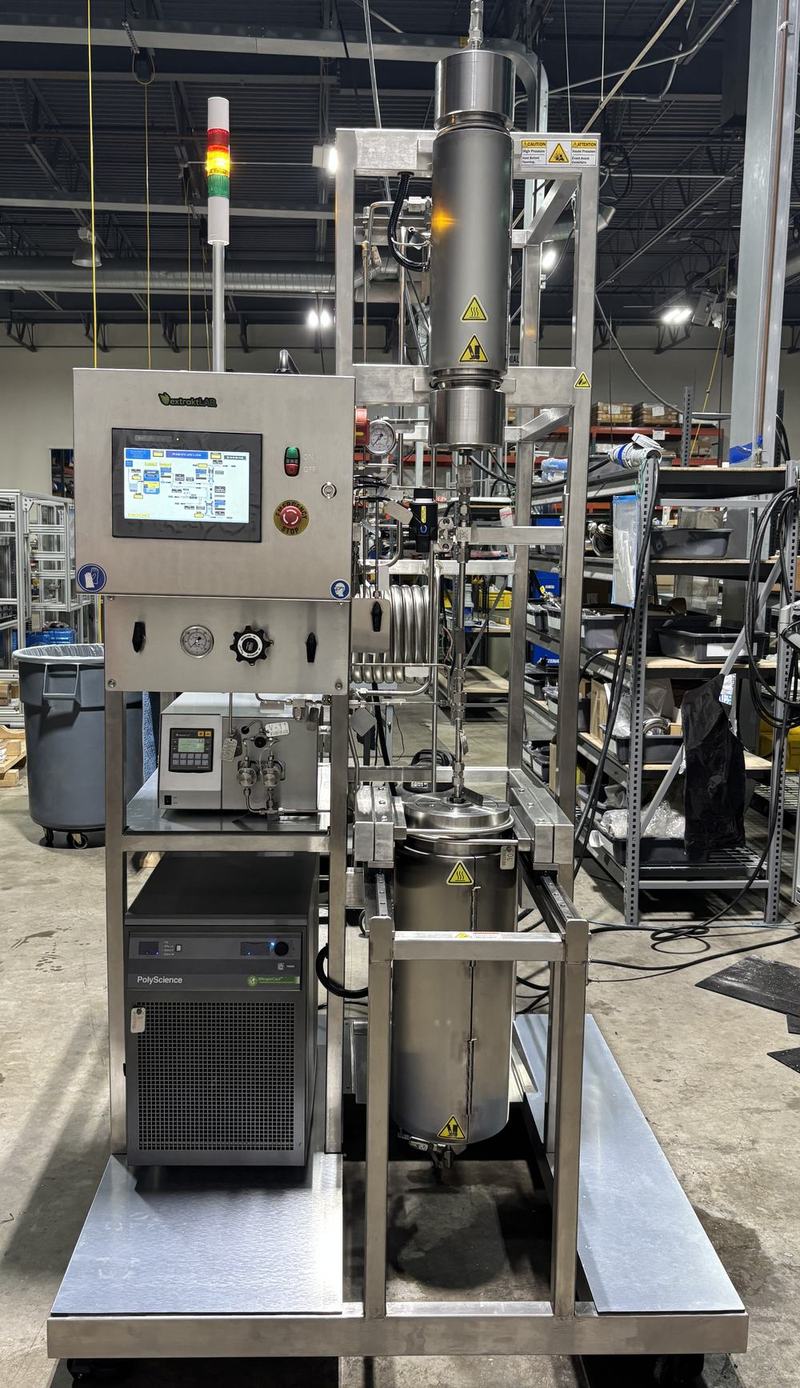
The ME-1.25 Molecular Encapsulator in a laboratory setting (illustrative image).
The ME-1.25 Molecular Encapsulator is extraktLAB’s lab-scale CO₂ system for formulation and particle engineering. It conditions an active and a carrier in a 1.25 L heated process vessel, then transfers them through a configurable mixer and nozzle into a 5 L receiver for cyclonic separation and powder recovery. Standard operating pressure is 276 bar (4,000 psi).
- No rotating agitators
- Independent mixer and receiver pressure
- HMI/PLC recipe control
By Jon Thompson, extraktLAB | Last updated: October 27, 2026

Not the M-2.5. The ME-1.25 is a molecular encapsulator. extraktLAB also sells products named M-2.5, the M-2.5 extractor and the M-2.5 ScCO2 Anti-Solvent Encapsulator. Those are different products from the ME-1.25.
What the ME-1.25 is for
The ME-1.25 is for teams that need to find out what works before they commit material, time or a larger machine. It puts CO₂-assisted formulation, encapsulation and particle engineering into one controlled lab-scale system, so you can screen carriers, routes and conditions on a small charge.
Poorly soluble actives
Cyclodextrin inclusion complexes and other active–carrier systems go straight at the solubility problem. Done well, encapsulation has delivered tremendous improvements in bioavailability and solubility. Results are formulation-specific, and the ME-1.25 lets you compare carriers and conditions on your own active.
Particle engineering
Pressure, temperature, preheating, CO₂ delivery, contact time, nozzle and receiver conditions are all set on the machine, so you can change one variable at a time and compare runs. Routes include precipitated and composite particles, lipid and polymer particles, liposome and vesicle suspensions, and active loading onto gums and dry carriers.
Less solvent
CO₂ leaves the process as a gas, so there is less solvent to remove, and a CO₂ route can sharply reduce organic solvent use and the VOC and HAP emissions that come with it. Dry-feed routes can avoid introducing bulk water and its removal.

How the ME-1.25 works
Select, prepare and condition
Select and prepare. Choose the active, the carrier, the feed composition and the output you want, and load the heated 1.25 L process vessel.
Condition with CO₂. Bottom filling and repressurization mix the formulation with CO₂. Contact time and pressure-pulse sequencing are selectable, and inline preheating, mixing-vessel temperature and collection temperature are controlled independently.
Transfer
A timed discharge sends the mixture through the selected mixer and nozzle into the 5 L receiver. Mixer pressure and receiver pressure are set independently, and receiver back pressure controls the discharge.
Recover and characterize
Cyclonic separation recovers the product in the receiver. Measure loading, recovery, particle or vesicle properties and product performance, then refine a repeatable recipe.
Key features
No rotating agitators
Pump-driven and pressure-pulsation mixing eliminates rotating agitators and the associated issues with unreliable shaft seals.
Independent mixer and receiver pressure
Set receiver back pressure for controlled discharge, cyclonic separation and removable powder recovery.
Independent temperature control
Inline preheating, mixing-vessel temperature and collection temperature are controlled separately.
Interchangeable discharge nozzles
Select nozzle bore and geometry for your formulation and its plugging tendency.
Recipe control
HMI/PLC recipes, automated valves, transfer timing, instrumentation and safety interlocks. Closed-loop process pressure control is optional.
Stainless steel construction
304 stainless-steel frame, brushed stainless-steel control enclosure, and 316/316L process tubing and fittings.
ME-1.25 specifications
| Specification | ME-1.25 (lab-scale) |
|---|---|
| Process vessel | 1.25 L, heated |
| Receiver | 5 L, for cyclonic separation and product recovery |
| Base operating pressure | 276 bar / 27.6 MPa (4,000 psi), set by the base pump configuration |
| Higher-pressure option | 450 bar (about 6,500 psi), custom option by quotation with a selected higher-capacity pump and coordinated valves, pressure protection and controls |
| Inline preheating | 100 °C (212 °F) maximum; configurable up to 130 °C (266 °F) when required |
| Vessel temperatures | Mixer and receiver up to 100 °C (212 °F), independent heater zones. Lower operating temperatures depend on the process chiller and the formulation |
| Mixing | Pump-driven and pressure-pulsation; no rotating agitator |
| Pressure control | Independent mixer and receiver pressure settings; closed-loop process pressure control is optional |
| Automation | HMI/PLC recipes, automated valves, transfer timing, instrumentation and safety interlocks |
| Electrical supply | Single phase, 208–240 V, 50 or 60 Hz. The process chiller has a separate supply |
| CO₂ and air | Compatible liquid CO₂ source and clean, dry regulated compressed air; connections and loads per utility drawing |
| Materials | 304 stainless-steel frame and brushed stainless-steel control enclosure; 316/316L process tubing and fittings. Wetted pump metals, seals and polymers follow the selected configuration |
The standard discharge nozzle has no dedicated temperature controller. Ask us for the utility drawing for your configuration.
Brochure: Download the ME-1.25 brochure (PDF, Rev 06).
What you can develop on the ME-1.25
The ME-1.25 is used for formulation development in pharmaceuticals, foods, nutraceuticals, flavors, fragrances and specialty materials. Six starting routes:
Cyclodextrin inclusion
Investigate host–guest complexes and loading of compatible lipid-soluble actives onto cyclodextrin carriers.
Dry carriers and natural gums
Explore active loading onto gum arabic, other hydrocolloids and prepared carriers. Dry-feed routes can avoid introducing bulk water and its subsequent removal.
Precipitated and composite particles
Study CO₂-assisted precipitation, antisolvent methods and active–carrier composites using selected liquid feeds and recovery routes.
Liposomes and vesicle suspensions
Develop compatible phospholipid formulations for hydrophilic or lipophilic payloads. Aqueous routes recover a wet suspension; drying is a separate step.
Lipid and polymer particles
Investigate CO₂ conditioning and expansion of compatible lipids and polymers for particle-formulation research.
Custom carrier systems
Screen proteins, starches, polysaccharides and carrier blends against loading, recovery and final-product requirements.
Custom arrangements can use two separately metered feeds and a common mixing chamber, with an additional downstream receiver. Mixing, feed preparation and recovery equipment are specified for the application.
Carrier compatibility and process configuration determine performance. Nozzle bore does not establish finished particle size; particle-size and throughput targets are demonstrated through application development.
Options, service and documentation
Every ME-1.25 is quoted to its configuration. The base system includes the main CO₂ pump. Selectable options:
- Co-solvent pump: liquid feed up to 300 mL/min with a 316 stainless-steel pump head.
- Injection pump: low-flow liquid injection up to 5 mL/min.
- Process chiller: a separate chiller for process cooling, or use your own.
- Closed-loop pressure control: automated closed-loop control of process pressure, in addition to the standard independent mixer and receiver pressure settings.
- Internal transfer basket / product container: a removable basket for collecting and transferring recovered product.
- CO₂ supply: bulk-storage tank and cage, and a separate CO₂ supply pump / MPCart booster (see MPCART and CO2 Cage).
- Higher pressure: a 450 bar (about 6,500 psi) configuration is a custom option with a selected higher-capacity pump and coordinated valves, pressure protection and controls. 276 bar (4,000 psi) is the standard operating pressure.
ME-1.25 or ME-2.5?
| ME-1.25 (lab scale) | ME-2.5 (pilot scale) | |
|---|---|---|
| Process vessel | 1.25 L | 2.5 L |
| Receiver | 5 L | 10 L |
| Base operating pressure | 276 bar (4,000 psi) | 276 bar (4,000 psi) |
| Higher pressure | 450 bar custom option | 450 bar custom option |
Choose the ME-1.25 when you are screening carriers, routes and conditions and the active is scarce or expensive, when a research lab shares one instrument across projects, or when you are building the method. Choose the ME-2.5 when you need larger batches for downstream testing or pilot work. Vessel size is a configuration difference, not a guarantee of throughput or of equivalent formulation results.
Is owning an encapsulator the right next step?
Ownership fits best when you have a named active–carrier or formulation question, access to fit-for-purpose analytical methods, a recurring project pipeline or a shared-use case, and a trained operator. If the application is still uncertain or the demand is occasional, start with a feasibility study before assuming equipment is the right step.
Downloads

ME-1.25 Molecular Encapsulator brochure
Lab-scale system. PDF, Rev 06.
Download the ME-1.25 brochure (PDF)
ME-2.5 Molecular Encapsulator brochure
Pilot-scale system. PDF, Rev 06.
Download the ME-2.5 brochure (PDF)Frequently asked questions
What is the ME-1.25 Molecular Encapsulator?
The ME-1.25 is extraktLAB’s lab-scale CO₂ system for formulation, encapsulation and particle engineering. A 1.25 L heated mixing vessel conditions the active and carrier, and a configurable mixer and nozzle transfer the mixture into a 5 L receiver for cyclonic separation and product recovery. Independent pressure and temperature settings let researchers develop and repeat formulation-specific processing methods.
How does the ME-1.25 work?
You condition the active and carrier in the heated 1.25 L process vessel and establish CO₂ contact. Pump-driven, pressure-pulsation mixing blends the formulation with CO₂, and contact time and pressure-pulse sequencing are selectable. A timed discharge then moves the mixture through the selected mixer and nozzle into the 5 L receiver, where the product is separated and recovered.
What pressure and temperature does the ME-1.25 run at?
The base operating pressure is 276 bar / 27.6 MPa (4,000 psi), set by the base pump configuration, and mixer and receiver pressure are controlled independently. A 450 bar (about 6,500 psi) configuration is a custom option. Inline preheating is 100 °C (212 °F) maximum, configurable up to 130 °C (266 °F). Mixer and receiver temperatures go up to 100 °C (212 °F) with independent heater zones; lower operating temperatures depend on the process chiller and the formulation.
What can I develop on the ME-1.25?
The ME-1.25 supports cyclodextrin inclusion complexes, active loading onto dry carriers and natural gums, precipitated and composite particles, liposome and vesicle suspensions, lipid and polymer particles, and custom carrier systems. Liposome routes in an aqueous medium recover a wet suspension, and drying is a separate step. Carrier compatibility and process configuration determine performance.
Does the ME-1.25 reduce solvent use?
CO₂ leaves the process as a gas, so there is less solvent to remove. A CO₂ route can sharply reduce the organic solvent used in a formulation, and that carries through to lower VOC and HAP emissions. Dry-feed routes can also avoid introducing bulk water and the step of removing it. An optional co-solvent pump (up to 300 mL/min) and an optional injection pump (up to 5 mL/min) are available when a route needs a liquid feed.
Will the ME-1.25 improve the bioavailability or solubility of my active?
Done well, encapsulation has delivered tremendous improvements in bioavailability and solubility. The result depends on the active, the carrier and the process, so it is established by testing your own formulation. Nozzle bore does not set the finished particle size either; particle-size and throughput targets are demonstrated through application development.
What is the difference between the ME-1.25 and the ME-2.5?
Scale. The ME-1.25 is the lab-scale system with a 1.25 L process vessel and a 5 L receiver. The ME-2.5 is the pilot-scale system with a 2.5 L process vessel and a 10 L receiver. Both run at 276 bar (4,000 psi) as standard and use the same CO₂ process. Vessel size is a configuration difference, not a guarantee of throughput or of equivalent formulation results.
Is the ME-1.25 related to the M-2.5?
No. The ME-1.25 Molecular Encapsulator is a different product from the M-2.5 extractor and from the M-2.5 ScCO2 Anti-Solvent Encapsulator. Each has its own specifications and brochure.
What utilities, options and documentation come with the ME-1.25?
The ME-1.25 runs on single-phase 208–240 V, 50 or 60 Hz power; the process chiller has a separate supply. It needs a compatible liquid CO₂ source and clean, dry regulated compressed air, with connections and loads given on the utility drawing. Options include closed-loop pressure control, a co-solvent pump, an injection pump, a process chiller, a CO₂ supply pump, a transfer basket, spares, service, an optional GMP documentation package and qualification services, and certification packages.
How do I get a quote for the ME-1.25?
Use the request form or call +1 651 600 0036. Tell us your active, carrier, feed composition and target product form, and we will define the equipment, the options and the development pathway for a quote. If your demand is occasional or the application is still uncertain, a feasibility study can come first.
Related equipment and guides
 ME-2.5 Molecular Encapsulator
The pilot-scale version, with a 2.5 L process vessel and a 10 L receiver.
- MPCART and CO2 Cage
CO₂ supply for the ME-1.25.
- Water-soluble β-cyclodextrin-oleoresin product development under CO₂
An extraktLAB worked example of cyclodextrin inclusion in CO₂.
- Feasibility study
Start with a study before buying equipment.
- Why supercritical CO₂
Background on CO₂ as a processing fluid.

Request a quote or a technical discussion for the ME-1.25
Tell us your active, carrier, feed composition and target product form. We will define the equipment, the selected options and the development pathway, and send a quote for your configuration.
Prefer to call or write? Phone +1 651 600 0036 or email sales@extraktlab.com.